
Building Partnerships Across Borders: A Case Study from BYC and CRJI
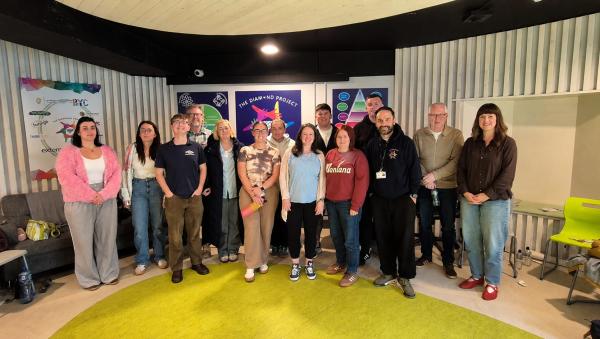
As part of our work on cross-border collaboration across the community and voluntary sector, The Wheel is sharing the experiences of organisations that have built meaningful partnerships across the island of Ireland.
In this Q&A, Belvedere Youth Club reflects on its five-year collaboration with Community Restorative Justice Ireland. From informal conversations to a growing strategic partnership, they reflect on the value of shared learning, restorative practice and relationship-building across borders.
Tell us a bit about your organisation
Belvedere Youth Club (BYC) is a community-based youth organisation serving the North East Inner City of Dublin. Founded in 1918, we have over a century of experience working with children, young people, and families in one of Ireland's most diverse and historically disadvantaged communities. Our vision is that all children and young people are supported and empowered to grow and develop key skills and competencies so they can become leaders and role models in their community.
BYC provides a vibrant, safe space where children and young people can come together with their peers and experience a sense of belonging. Our programmes are delivered through a range of settings: after-schools and homework clubs, street work and outreach, drop-ins, structured groups, one-to-one support, residentials, and international youth exchanges. We work with children and young people across all age groups (7–25 years) through five core pillars: Performance & Creative Arts, Sports & Wellbeing, Education & Personal Development, Summer Programmes, and European Exchanges & Residentials.
A defining feature of BYC is our commitment to Restorative Practice (RP). Since 2018, we have embedded restorative principles across our governance, staffing, and programmes. This commitment was recognised when BYC was selected as the host organisation for the Diamond Project, a community-based probation initiative delivering a multi-agency, relationship-focused response to children and young people involved in or at risk of involvement in the youth justice system. The Diamond Project works with the Probation Service and Department of Justice, providing systemic family therapy, restorative circles, and specialist support for families affected by Drug-Related Intimidation.
BYC has also developed significant European expertise. We are an Erasmus+ accredited organisation and recently led the READY Programme, a two-year Erasmus+ project with partners in three countries, developing a toolkit for youth workers based on teen yoga and restorative practices. BYC was also shortlisted as a finalist for the Employer Excellence award with the Charities Institute Ireland.
Our partner in our cross-border work, Community Restorative Justice Ireland (CRJI), is the leading expert organisation in restorative justice with young people in conflict with the law in Northern Ireland, with over twenty years of experience delivering restorative justice programmes. CRJI works across traditional community divides in Belfast and Derry, with established relationships with the PSNI, the Public Prosecution Service, the Department of Justice, and Health and Social Care Trusts. CRJI is accredited by the Department of Justice, and its Restorative Practitioners form part of the DoJ Hub.
What was your journey towards cross border collaboration like?
Shared communities, shared challenges
Our journey began over five years ago through informal practitioner networks. Youth workers from BYC and CRJI recognised that we were facing similar challenges. Both organisations are rooted in working-class urban communities that have experienced generations of marginalisation, economic disadvantage, and social exclusion. BYC serves the North East Inner City of Dublin, an area characterised by significant deprivation, with pockets of extreme disadvantage alongside new communities and significant development. CRJI serves communities in Belfast and Derry that have experienced similar patterns of poverty, social exclusion, and the lasting impacts of conflict.
The children and young people we work with face comparable barriers: exclusion from mainstream education, limited access to employment pathways, mental health challenges, family breakdown, and involvement in the justice system. Both organisations are responding to young people who are often seen as "hard to reach" but whom we reach through consistent, relationship-based youth work.
Shared approaches and values
Most importantly, both organisations share a deep commitment to Restorative Practice as the foundation of all our work. For BYC, Restorative Practice is at the heart of how we enhance all our relationships and respect each other. For CRJI, restorative justice is the core methodology for working with young people in conflict with the law. This shared values base, rooted in relationships, accountability, repair, and the belief that every young person has potential, is what made the collaboration possible.
We realised that neither jurisdiction had a perfect model. BYC had expertise in universal youth work, after-schools and homework support, employability programmes, and European youth work and exchanges. CRJI had expertise in restorative justice with young people in conflict with the law, cross-community work, and navigating complex statutory relationships. Together, we could build a stronger, more complete response to the needs of young people on both sides of the border.
Activities over the past five years have included:
Shared training events: CRJI staff have participated in restorative practice training sessions in Dublin, hosted by BYC and involving local experts. Such exchanges have deepened both organisations' understanding of how restorative approaches can be applied across universal youth work, youth justice, and community settings.
Cross-border study visits: Youth workers from Dublin have visited CRJI projects in Derry to learn about their practice. CRJI teams have recently visited BYC's Diamond Project and have met with representatives from other projects working with harder to reach young people to hear about new transferable resources.
Practice exchange forums: Ad hoc virtual and in-person meetings where practitioners share case studies, challenges, and emerging practice.
Joint conference presentations: BYC representatives have spoken and participated in a CRJI hosted conference in Derry, while most recently, BYC has presented at The Wheel's Summit on cross-border collaboration, sharing our five-year journey with other community and voluntary sector organisations.
Joint funding applications: We have collaboratively developed funding proposals to develop cross-border Restorative Practice resources and research on responses to exploitation.
Shared policy learnings: BYC has learned from CRJI's experience of cross-community work in a post-conflict society; CRJI has learned from BYC's experience of integrating new communities and responding to increasing diversity in Dublin's North East Inner City.
What have you learned from the experience? Are there any challenges you have had to overcome?
Key learnings
Cross-border collaboration does not require a formal structure to start. Our relationship began informally, with no budget or work plan. What mattered was a shared commitment to restorative values and a willingness to be vulnerable, to admit that we don't have all the answers and that we can learn from colleagues across the border.
Different legal and policy contexts are a strength, not a barrier. The Republic of Ireland and Northern Ireland have different youth justice systems, policing structures, and statutory frameworks. Rather than being a problem, this difference has been an important learning asset. We have learned from each other on responding to diversity.
Shared language takes time to develop. We use similar words – "restorative", "diversion", "exploitation", "hard to reach", but they can mean different things in different jurisdictions. Regular, open conversation has been essential to build a genuinely shared understanding.
Restorative Practice provides a strong foundation for collaboration. Because both organisations are rooted in restorative principles, we share a common ethos about relationships, respect, and repair. This has made conversations easier and has kept the collaboration focused on outcomes for young people.
Shared values transcend borders. Whether in Dublin, Belfast, or Derry, young people face similar barriers to education, employment, and wellbeing. A commitment to relationship-based, restorative youth work is a powerful connector across jurisdictions.
Challenges overcome
Lack of dedicated funding: For four years, our collaboration was entirely unfunded, relying on goodwill and small amounts of time stolen from other duties. This limited the scale and depth of what we could achieve. We have now addressed this by jointly developing funding applications to PEACEPLUS and the Shared Island Civic Society Fund.
Cross-border distances and logistics: Virtual meetings (Zoom/Teams) allow for regular check ins and planning sessions, while preserving in-person connection for relationship-building.
Different organisational cultures: BYC is a large, multi-service youth organisation with a wide range of programmes. CRJI is a specialist restorative justice provider. We continue to learn from each other's ways of working, including reporting requirements, and decision-making processes.
Sustaining momentum without dedicated resource: Maintaining a five-year relationship without dedicated funding required intentional effort. We made space for regular check-ins, celebrated small wins, and kept focused on the shared mission.
How has this experience helped to grow or strengthen your organisation?
For BYC
Enhanced credibility in restorative practice: Being able to point to a five-year cross-border partnership with CRJI has strengthened our reputation for building restorative youth work practice. This aligns with our strategic goal to be recognised as a restorative hub within our community.
Broader perspective on youth work: The collaboration has deepened BYC's understanding of how cross-community work functions in a post-conflict society, informing our own work with diverse communities in Dublin's North East Inner City, including new communities and migrant populations.
New programme ideas: Exposure to CRJI's model has influenced BYC's Diamond Project, particularly in how we engage with young people affected by coercion and intimidation, as well as how we work with families across multiple statutory systems.
European connections: We intend to build on our Erasmus+ accreditation and our leadership of the READY Programme to work within European networks and build on opportunities as CRJI can access these programmes from 2027.
Staff development: BYC staff who have participated in exchange visits and conferences have developed new skills, increased confidence, and a broader understanding of youth justice and community work across the island.
Policy influence: The collaboration has deepened BYC's understanding of cross-border issues affecting children and young people, strengthening our ability to advocate locally and nationally on issues such as educational exclusion, employment barriers, youth justice, and community safety.
For the partnership as a whole
The collaboration has matured from informal exchange to a partnership that is aiming for increased opportunities for shared work and a pipeline for future funding. If successful, we will work to produce the first cross-border Restorative Practice Toolkit for youth work settings – a resource that does not currently exist, covering universal youth work, youth justice, education support, employability, and responses to exploitation.
What would you tell others who are embarking on their cross-border collaboration journey?
Start small and informal. You do not need a funded project to begin. Start with a conversation, a shared training day, or a study visit. Trust and relationships come before work plans and budgets. Our five-year journey began with some simple conversations about our work.
Embrace the differences. Do not try to pretend the border does not exist. Different legal systems, policing structures, and policy contexts are important learning assets. It's a good idea to always be curious about how your partner does things and be honest about what you do not know.
Focus on shared values, not just shared problems. It is easy to start with the challenges - issues of poverty, exclusion, exploitation. But our collaboration has been sustained by shared values. For BYC and CRJI, Restorative Practice provides a common language and a common framework for how we work with young people, how we treat each other, and how we handle conflict.
Invest in shared language. Do not assume that the same words mean the same thing on both sides of the border. Make space for open conversation about terminology, values, and assumptions. We have ensured that when we come together, we allow time and space to unpack language and assumptions.
Be patient and persistent. Funding applications may fail before they succeed. But the relationships you build will outlast any single project. As BYC's strategy says, we understand that the lives of children and young people are enhanced when we work together.
Final reflections
Our recent funding proposals represent a maturation of our collaboration. What began as informal conversations has become a structured and ambitious partnership with the potential to benefit youth workers and young people across the island of Ireland. BYC's strategic plan 2026–2031 explicitly commits to continuing work with European partners and seeking additional opportunities to develop innovative programmes. Our collaboration with CRJI is a clear example of that commitment in action.
We are grateful to The Wheel for the opportunity to share our journey. We hope it encourages other community and voluntary sector organisations to explore cross-border collaboration, not as a bureaucratic exercise, but as a genuine learning relationship built on shared values and mutual respect.