
International Women's Day 2026: Rights, Justice, Action, For All Women and Girls
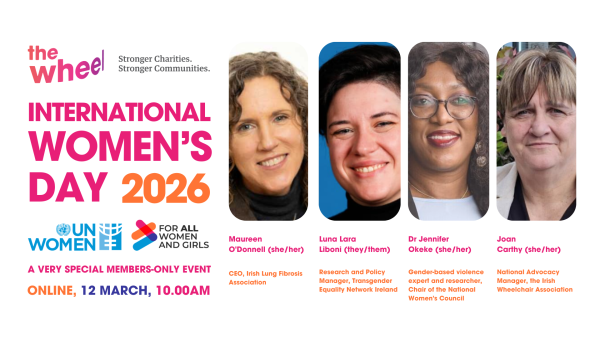
To mark International Women’s Day 2026, The Wheel hosted a webinar for our members exploring this year’s theme: “Rights. Justice. Action. For ALL Women and Girls.” The Wheel’s EDI committee brought together advocates working across disability rights, transgender equality and gender-based violence prevention to reflect on how equality work can become more inclusive, collaborative and effective.
Moderated by one of our Trustees, Maureen O’Donnell, CEO of the Irish Lung Fibrosis Association, the panel featured:
- Joan Carthy, National Advocacy Manager with the Irish Wheelchair Association
- Luna Lara Liboni, Research and Policy Manager with Transgender Equality Network Ireland (TENI)
- Dr Jennifer Okeke, gender-based violence expert and researcher, and Chair of the National Women’s Council.
Throughout the discussion, one message stood out: progress happens through active solidarity, shared learning and sustained collective action.
You can watch our recording of the event over on YouTube.
Personal Experience and Collective Action
For each of the panellists, personal experience played an important role in shaping their advocacy.
Dr. Okeke reflected on how lived experience can become a catalyst for activism. Challenging long-standing structures and systems can be slow and difficult work, she noted, but personal conviction and shared purpose help sustain momentum. She emphasised that activism is rarely an individual effort — networks and collective action are essential to achieving change.
Similarly, Luna Lara Liboni spoke about how barriers experienced by marginalised communities can drive people to become advocates. They highlighted the role policy plays in shaping people’s everyday experiences and stressed the importance of addressing structural barriers that prevent people from living full and happy lives.
Joan Carthy also described how individual advocacy work can provide powerful insight into the lived experiences of others. Through supporting individuals, advocates gain a deeper understanding of systemic barriers and unmet needs, which can shape wider advocacy efforts and policy change.
Why Intersectionality Matters
Intersectionality was a key theme of the discussion.
Conversations about equality can sometimes fall into what author Chimamanda Ngozi Adichie describes as “the single story.” When issues are viewed only through one lens — such as gender alone — many of the layers shaping women’s lives can be overlooked.
Approaching equality through a single perspective risks missing the complex realities of people’s lives. Many women experience overlapping forms of discrimination — for example related to disability, race, gender identity or socioeconomic status. An intersectional approach helps uncover these layers and better understand the barriers people face.
The panel emphasised the importance of asking critical questions when thinking about inclusion. Who is in the room? More importantly, who isn’t— and why? Reflecting on what prevents people from participating, and how organisations may unintentionally contribute to those barriers, is an important step towards building truly inclusive spaces.
Ireland’s community and voluntary sector play an important role here. Strong networks of organisations representing diverse communities can help ensure that a wider range of voices and lived experiences are included in discussions about policy, advocacy and social change.
At the same time, the panel noted that equality work should not mean people must spend their lives fighting systems. A more inclusive society is one where everyone has access not only to rights, but also to opportunities, participation and joy.
Getting Involved in Advocacy
The conversation also explored how people can begin engaging in activism and advocacy.
A helpful starting point is identifying the issues that matter most personally and connecting with organisations already working in that space. Advocacy can take many forms and happens at multiple levels — from individual actions and community organising to national campaigns and policy change.
The panel also acknowledged that many people experience imposter syndrome when thinking about activism, even when they are already contributing to positive change. Meaningful impact often begins with small steps: talking to others, supporting campaigns or using personal skills and networks to amplify important issues.
Activism does not always mean leading large campaigns or protests. Everyday actions — how we support others, how we challenge injustice, and the conversations we choose to engage in — can also contribute to meaningful change.
Building Inclusive Leadership
Another topic discussed was how organisations can recruit and retain board members and leaders who reflect the communities they serve.
Reaching new audiences requires patience, persistence and creativity. Organisations may need to rethink how they communicate opportunities and adapt their approaches to engage people who may not traditionally see governance roles as accessible to them.
Creating an enabling environment for participation is also key. Flexible approaches to volunteering and governance — such as recognising caring responsibilities or offering different levels of time commitment — can help ensure more people are able to contribute.
The panel also emphasised the importance of recognising lived experience as expertise. People directly affected by social issues bring valuable insights that should be welcomed in leadership and decision-making spaces.
At the same time, the conversation acknowledged the risk of burnout in advocacy work, particularly for those most affected by inequality. Advocacy can be emotionally demanding, especially for people whose lived experience is at the centre of the issues being addressed. Sharing responsibility across wider groups can help ensure that the work remains sustainable and does not fall on the shoulders of the same individuals.
The Role of Allyship
The discussion concluded with reflections on allyship and solidarity.
Supporting equality means recognising that even when an issue does not directly affect someone, they may still be connected to the systems that shape those experiences. Listening, learning and engaging with organisations working on the ground are important steps towards meaningful allyship.
Speaking out when injustice occurs and supporting campaigns led by affected communities were also highlighted as ways to strengthen collective action.
Continuing the Work
The conversation reinforced that achieving rights, justice and equality for all women and girls requires ongoing collaboration across the community and voluntary sector.
Through campaigns, advocacy initiatives and training opportunities offered by organisations such as Transgender Equality Network Ireland and the Irish Wheelchair Association, there are many ways for individuals and organisations to get involved.
As the panel highlighted, we have the power to cocreate a society that actively includes rather than marginalises. Through our personal experiences of exclusion, we can understand and fight against the oppression of others. Advancing equality takes many forms — from advocacy and policy work to education, awareness and everyday acts of solidarity. Everyone has a role to play in ensuring that the pursuit of rights, justice and equality truly includes all women and girls.